Hannover-Fieldday 2012, Tag 1 (Freitag)

An diesem Wochenende findet der Hannover-Fieldday auf dem Kronsberg statt. Allgemeine Informationen dazu sind auf www.baerenfunk.de zu finden.
An dieser Stelle mein persönliches Fieldday-Tagebuch.

10:00: Mein Wecker klingelt zu dieser nicht gerade studentenfreundlichen Zeit. Funkgerät eingeschaltet und gleich erstmal den Kronsberg gerufen. Stefan, DO7OZ, hat einen Frühstart hingelegt und ist bereits seit gestern Abend dort. Und nicht nur das: Die erste Hälfte einer Delta-Loop für 160m hängt auch bereits in der Luft.

11:15: Treffen mit Roland, DF1OE. Erste Feststellung: Um einen Anhänger zu mieten, braucht man seinen Ausweis. Also nochmal ab nach Hause…

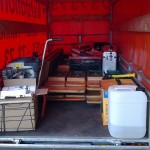
11:40: Hat jemand daran gedacht, vorher mal zu messen, wie lang eine Bierzeltgarnitur ist? Nein, natürlich nicht. Zum Glück weiß es ein OM auf DB0FUS.

11:43: Anhänger ist gemietet. Roland stellt fest, dass er keine Anhängerkupplung hat.

11:45: Roland hat seine Anhängerkupplung gefunden. Es geht los, zunächst zu PPC, dann weiter zum Lindener Berg.

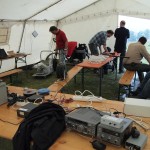
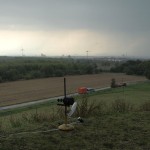
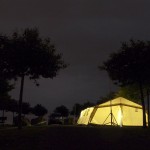
14:30: Ankunft auf dem Kronsberg. Die Organisation klappt wesentlich besser als im letzten Jahr und das Zelt steht innerhalb kurzer Zeit. Jetzt schnell zum Supermarkt und alles für die Verpflegung kaufen. Doch kaum ist der Nanowellengenerator gezündet, bricht ein Gewitter mit Starkregen (und zeitweise sogar Hagel) los, wie es lange keins gegeben hat. Angekündigt waren „leichte Schauer“ mit <1mm Niederschlag. So, wie es auf dem nebenbei verfolgten Regenradar aussieht, hatte in ganz Norddeutschland nur Hannover das zweifelhafte Vergnügen in dieser Form – der Fleck auf der Karte wollte sich einfach nicht von der Stelle bewegen. An Antennenbau ist nicht zu denken. Es bleibt uns nichts anderes übrig, als die Stationen soweit aufzubauen und im Zelt abzuwarten. Wenigstens läuft wie schon im Vorjahr die von Wilfried, DJ1WF, zur Verfügung gestellte ATV-Station auf Anhieb problemlos, sodass Live-Unwetterbilder über DB0TVH zu sehen sind.
Tom, DL9OBD und Stefan, DO7OZ, improvisieren derweil einen Regenschutz für den Grill und versorgen in einer Phase schwächeren Regens das inzwischen sehr hungrige Aufbauteam mit Würstchen und Steaks.
Immerhin lässt sich der Stromgenerator nicht wesentlich beeindrucken und läuft verlässlich weiter.

20:00: Der Regen lässt langsam nach. Nun kann ich es nicht mehr erwarten und hänge 20m endgespeistes Lautsprecherkabel sehr provisorisch auf. Ein erstes PSK31-QSO auf 30m mit Polen klappt sofort mit 59+, allerdings kriegt mein Netbook dabei offensichtlich mehr HF ab, als es gern hätte.
Zwischenzeitlich versogt Lars, DH1OF die durchgeregnete und -gefrorene Truppe mit heißen Würstchen und leckerem Kaffee, natürlich aus eigener Rösterei. Michael, DO1HMB schaut ebenfalls vorbei und steuert etwas Treibstoff für den Generator sowie gekochte Wachteleier (aus eigener Produktion!) bei.

20:20: Stefan, DO7OZ, empfängt den 160m-Rundspruch aus Berlin auf 1852 kHz. Das Signal ist glasklar und weit über S9 zu empfangen. Das beweist: Die Delta-Loop funktioniert fantastisch!

22:00: Nun steht auch endlich der Rundstrahler für UKW, sodass die Kommunikation via DB0FUS sowie per 2m-Direktfrequenz nun auch von den provisorisch genutzten Handfunkgeräten auf die „richtige“ Station verlegt werden kann.
Langsam kann der eigentliche Fieldday beginnen.

23:00: Roland, DF1OE, improvisiert einen Dipol und aktiviert nun das 80m-Band in Phonie.

23:40: Die ersten Besucher sind hier und zeigen sich durchaus interessiert am ATV- und Kurzwellenbetrieb. Ich habe gerade ein nettes und vorführtaugliches PSK-QSO auf 80m mit einem OM aus Mosbach – mit gerade mal 10 Watt PEP und der improvisierten Antenne. Hier macht sich ganz klar der vorteilhafte Standort bemerkbar.

0:15: Die erste DX-Verbindung (JX9JKA) auf 80m ist im Log.

1:04: Ich steige in die Bahn nach Hause, während auf dem Kronsberg langsam Ruhe einkehrt. Fazit des ersten Tages: Statt schlechter Planung behinderte diesmal schlechtes Wetter den Aufbau.

Hier noch ein paar erste Impressionen:
„Receiving“ bat calls in slow-motion without special equipment

It might be coincidence, but I know several radio amateurs who are also interested in nature, especially in bats. Maybe that is because a „bat detector“ is also a nice little soldering project.
In this article however, I will explain a way of listening to bats without such a detector.

Bat calls have various frequencies, depending on species and purpose. The spectrum ranges from 20 kHz up to 60 kHz (and sometimes even more). Now I’m not a bat expert, but from my experience a good starting point is a frequency of about 40 kHz (we will pick up on this later).
Conventionally, one would use an ultrasonic microphone and a mixer with a VFO to mix the bat calls down into the audible spectrum – basically, this setup is nothing more than a VLF SSB receiver with a microphone instead of an antenna.

I own a „bat detector“ that works exactly this way (using the ultrasonic receiver of a car parking system – they are cheap and highly available, just in case you’re looking for something like that), but earlier this year I also got a Zoom H1 handheld recorder. It’s intended to record music (which it does quite good at, unless it becomes too loud, like with my band…), and originally I used it for exactly that. But this recorder has the nice trait of being able to record uncompressed PCM audio at 96 kHz sampling rate and 24 Bit depth. Following the nyquist theorem, the highest possible audio frequency to be recorded would be 48 kHz – that’s more than enough to include the bat calls around 40 kHz we want to record!
With these thoughts, I was curious to find out whether the H1 was able to record bat calls directly, without the usage of any converter. At first I was quite doubtful about that, because most electret condenser microphone capsules available on the market don’t go far beyond 20 kHz (end of the audible spectrum for most people). Also, I’d expect such a recorder to have some kind of lowpass filter to cut off ultrasonic sound. But it does work, and even better than I imagined it would!

So, how do you practically do it?
At first you need, of course, a place that has bats. In the area where I live, you have good chances of finding bats around slower water streams or lakes with a lot of trees near to them. If you don’t already know where to find bats, you could also contact a local nature conservation group and ask them. Wind noises can be a big problem, so it would be best to wait for an (almost) windless night.
Secondly, you will need some kind of recorder like I described. It doesn’t have to be the Zoom H1, others will probably do the job just as well, as long as they can record uncompressed audio at a sampling rate of 96 kHz (or more). If you own a mobile computer with a soundcard capable of doing that, you might try that as well – just make sure to use condenser mics, dynamic capsules won’t work.
At last, you need some kind of basic audio editing software. I’m using Audacity, which can be downloaded for free.

Place the recorder on some kind of steady surface to avoid noise by your hands – a bench, handrail or bigger stone will do. If you have one, use a tripod. Turn up the recording volume all the way, unless you should get distortion. As recording parameters, select WAVE/PCM (MP3 compression would eliminate that what we want to record) and 96 kHz sampling rate. If you can, choose 24 Bit depth – the more dynamic range, the better. Now hit the button and record for a few minutes (I wouldn’t recommend more than 10 minutes in one go to avoid getting very large files).
Load the recorded file into your editing programm and lower the playback sampling rate – I chose 8 kHz (in Audacity, that is done like in this picture). Extremely important: Do not resample anything, which would mean to re-calculate the audio track with a lower rate! The data must remain intact and just be played back much slower. With 96 kHz -> 8 kHz we have a ratio of 1/12th the original speed. That means that one minute of recorded audio is now twelve minutes long and a tone of 12 kHz is now 1 kHz. So the bat sounds at ultrasonic 40 kHz become conveniantly-listenable 3,3 kHz.
Done? Almost. To improve quality, use an equalizer to cut off the part of the spectrum that was initially audible. 20 kHz divided by 12 is 1,66 kHz, so cutting off everything below 1,5 kHz should be fine. As the final step, normalize that what is left over.

In my case, the result sounds like this: MP3 file (~400 kB)

I was quite impressed not only by how good this works, but also by the echo you can hear – it sounds almost like in some submarine movie (no surprise, because it’s the same technical principle). Also, it’s amazing what sophisticated systems evolution gave those cute little bats.

Have fun trying this yourself! If you have questions or results you want to share, feel free to comment!

Willkommen!

Als ich 2006, kurz nach der bestandenen Amateurfunkprüfung, in den DARC eintrat, legte ich mir dort auch eine Mitgliedshomepage an. Damals noch als statisches HTML mit einem WYSIWYG-Editor, der, wie ich leider erst zu spät bemerkte, fürchterlich chaotischen Code erzeugte.
In den letzten 2-3 Jahren lag diese Seite dann aus Zeit- und Aktivitätsmangel relativ brach. Zudem empfinde ich das Konzept einer statischen Homepage für meine Zwecke nicht mehr als zeitgemäß. Daher habe ich das neue Rufzeichen nun zum Anlass genommen, keine halben Sachen zu machen, sondern gleich etwas komplett neues zu beginnen – dies ist nun das Ergebnis.

Inhaltlich wird es natürlich hauptsächlich um Amateurfunk gehen, aber durchaus auch um andere Themen aus Wissenschaft, Technik und allem, was sonst noch so interessant ist.
Diese Seite soll jedoch kein allgemeines Nachrichtenportal zu den genannten Themen werden, sondern primär eine Plattform zur Publikation eigener Artikel.

Eventuell werde ich im Lauf der Zeit auch ein paar Inhalte der alten Seite wieder einstellen. Bis auf weiteres ist außerdem die alte Downloads-Seite noch online.

Viel Spaß beim Lesen!
vy 73s, DJ6DP